Tuesday, February 10, 2015

How to change your ip address


If you want to change your IP address on your home computer, there are few ways that might work for you—some simple, some not. Before trying more complicated/technical methods described below, you can try something that's very easy.
  • Simply turn off or unplug your modem for about five minutes. (You don't have to turn your computer off.) In many cases this alone will change your IP address when you go back online.
  • If that doesn't work, try unplugging your modem overnight and checking your IP address the next morning.
To check the IP address you're currently using, simply go to our homepage. Hopefully one of these simpler steps will give you the result you wanted.

Have laptop, go mobile

If you have a laptop, you can switch to a new IP address very easily, if only temporarily—but you can do it anytime you want.
Just go to any coffee shop, bookstore or other place that offers free wireless Internet (Wi-Fi®). Your IP address will automatically change because you'll be using a different Internet connection to send email or join chat rooms.

How about a proxy?

If you're trying to change your IP address primarily because you want to access web-based forums, you may wish to look into using a proxy server. Learn more by reading our article on proxies.

What next?

If you're not the technical type, contact your Internet service provider (ISP) and ask them if they are able to change your IP address or how long your connection needs to be off for your IP address to change.
If you're up for more-advanced methods, and you use Windows, try the steps below and see if your IP address changes.

For Windows users

- Computer connected directly to a cable or DSL modem
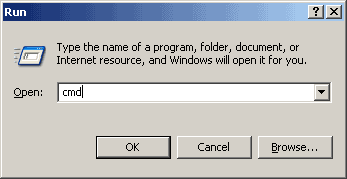
  1. Get to a command prompt. (START, run, cmd).
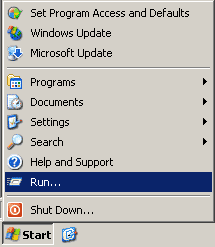
    Start Menu Run Box
  2. Type "ipconfig /release" (without the quotes, on the command line by itself).
  3. Shut down computer.
  4. Turn off computer.
  5. Turn off all ethernet hubs/switches.
  6. Turn off cable/DSL modem.
  7. Leave off overnight.
  8. Turn everything back on.

For networks using a Router

  1. Log into the router's admin console. (Often http://192.168.1.1/)
  2. Release the IP address (method varies by router manufacturer)
  3. Turn off router, ethernet hubs/switches, and the cable/DSL modem
  4. Leave off overnight
  5. Next day, turn everything back on
If you are using a cable/DSL modem and a router, you may wish to connect your computer directly to the cable/DSL modem. Please note that this could significantly impact your system security.
If you have a router and you're still not having any luck, check to see if there is a "Clone MAC Address" option. Using it should change your IP address; however, in most cases you'll only be able to do it once.

Ip Address:
IP address From Wikipedia, the free encyclopedia For the Wikipedia user access level, see Wikipedia:User access levels#Unregistered_users. Page semi-protected An Internet Protocol address (IP address) is a numerical label assigned to each device (e.g., computer, printer) participating in a computer network that uses the Internet Protocol for communication.[1] An IP address serves two principal functions: host or network interface identification and location addressing. Its role has been characterized as follows: "A name indicates what we seek. An address indicates where it is. A route indicates how to get there."[2] The designers of the Internet Protocol defined an IP address as a 32-bit number[1] and this system, known as Internet Protocol Version 4 (IPv4), is still in use today. However, due to the enormous growth of the Internet and the predicted depletion of available addresses, a new version of IP (IPv6), using 128 bits for the address, was developed in 1995.[3] IPv6 was standardized as RFC 2460 in 1998,[4] and its deployment has been ongoing since the mid-2000s. IP addresses are binary numbers, but they are usually stored in text files and displayed in human-readable notations, such as 172.16.254.1 (for IPv4), and 2001:db8:0:1234:0:567:8:1 (for IPv6). The Internet Assigned Numbers Authority (IANA) manages the IP address space allocations globally and delegates five regional Internet registries (RIRs) to allocate IP address blocks to local Internet registries (Internet service providers) and other entities. Contents 1 IP versions 1.1 IPv4 addresses 1.1.1 Classless subnetting 1.1.2 Classful subnetting (historical) 1.2 IPv4 address exhaustion 1.3 IPv6 addresses 1.3.1 IPv6 private addresses 2 IP subnetworks 3 IP address assignment 3.1 Methods 3.2 Uses of dynamic address assignment 3.2.1 Sticky dynamic IP address 3.3 Address autoconfiguration 3.4 Uses of static addressing 4 IP addressing 5 Public and Private Addresses 5.1 Public addresses 5.2 Private addresses 6 Modifications to IP addressing 6.1 IP blocking and firewalls 6.2 IP address translation 7 Diagnostic tools 8 See also 9 References 10 External links IP versions Two versions of the Internet Protocol (IP) are in use: IP Version 4 and IP Version 6. Each version defines an IP address differently. Because of its prevalence, the generic term IP address typically still refers to the addresses defined by IPv4. The gap in version sequence between IPv4 and IPv6 resulted from the assignment of number 5 to the experimental Internet Stream Protocol in 1979, which however was never referred to as IPv5. IPv4 addresses Main article: IPv4 § Addressing Decomposition of an IPv4 address from dot-decimal notation to its binary value. In IPv4 an address consists of 32 bits which limits the address space to 4294967296 (232) possible unique addresses. IPv4 reserves some addresses for special purposes such as private networks (~18 million addresses) or multicast addresses (~270 million addresses). IPv4 addresses are canonically represented in dot-decimal notation, which consists of four decimal numbers, each ranging from 0 to 255, separated by dots, e.g., 172.16.254.1. Each part represents a group of 8 bits (octet) of the address. In some cases of technical writing, IPv4 addresses may be presented in various hexadecimal, octal, or binary representations. Classless subnetting IP networks are groups of adjacent addresses that are usually are routed similarly. Modern IP networks use Classless Inter-Domain Routing where any subnetwork has a common prefix where all bits in the address are identical. Network blocks are written with CIDR notation with an IP address giving the prefix, a slash character, and the number of bits in the prefix. For example, 192.0.2.0/24 indicates there are 24 bits in the network, and they are 192.0.2. Classful subnetting (historical) In the early stages of development of the Internet Protocol,[1] network administrators interpreted an IP address in two parts: network number portion and host number portion. The highest order octet (most significant eight bits) in an address was designated as the network number and the remaining bits were called the rest field or host identifier and were used for host numbering within a network. This early method soon proved inadequate as additional networks developed that were independent of the existing networks already designated by a network number. In 1981, the Internet addressing specification was revised with the introduction of classful network architecture.[2] Classful network design allowed for a larger number of individual network assignments and fine-grained subnetwork design. The first three bits of the most significant octet of an IP address were defined as the class of the address. Three classes (A, B, and C) were defined for universal unicast addressing. Depending on the class derived, the network identification was based on octet boundary segments of the entire address. Each class used successively additional octets in the network identifier, thus reducing the possible number of hosts in the higher order classes (B and C). The following table gives an overview of this now obsolete system. Historical classful network architecture Class Leading bits Size of network number bit field Size of rest bit field Number of networks Addresses per network Start address End address A 0 8 24 128 (27) 16,777,216 (224) 0.0.0.0 127.255.255.255 B 10 16 16 16,384 (214) 65,536 (216) 128.0.0.0 191.255.255.255 C 110 24 8 2,097,152 (221) 256 (28) 192.0.0.0 223.255.255.255 Classful network design served its purpose in the startup stage of the Internet, but it lacked scalability in the face of the rapid expansion of the network in the 1990s. The class system of the address space was replaced with Classless Inter-Domain Routing (CIDR) in 1993. CIDR is based on variable-length subnet masking (VLSM) to allow allocation and routing based on arbitrary-length prefixes. Today, remnants of classful network concepts function only in a limited scope as the default configuration parameters of some network software and hardware components (e.g. netmask), and in the technical jargon used in network administrators' discussions. IPv4 address exhaustion IPv4 address exhaustion is the decreasing supply of unallocated Internet Protocol Version 4 (IPv4) addresses available at the Internet Assigned Numbers Authority (IANA) and the regional Internet registries (RIRs) for assignment to end users and local Internet registries, such as Internet service providers. IANA's primary address pool was exhausted on 3 February 2011, when the last 5 blocks were allocated to the 5 RIRs.[5][6] APNIC was the first RIR to exhaust its regional pool on 15 April 2011, except for a small amount of address space reserved for the transition to IPv6, intended to be allocated in a restricted process.[7] IPv6 addresses Main article: IPv6 address Decomposition of an IPv6 address from hexadecimal representation to its binary value. The rapid exhaustion of IPv4 address space, despite conservation techniques, prompted the Internet Engineering Task Force (IETF) to explore new technologies to expand the addressing capability in the Internet. The permanent solution was deemed to be a redesign of the Internet Protocol itself. This next generation of the Internet Protocol, intended to replace IPv4 on the Internet, was eventually named Internet Protocol Version 6 (IPv6) in 1995.[3][4] The address size was increased from 32 to 128 bits or 16 octets. This, even with a generous assignment of network blocks, is deemed sufficient for the foreseeable future. Mathematically, the new address space provides the potential for a maximum of 2128, or about 3.403×1038 addresses. The primary intent of the new design is not to provide just a sufficient quantity of addresses, but rather to allow an efficient aggregation of subnetwork routing prefixes at routing nodes. As a result, routing table sizes are smaller, and the smallest possible individual allocation is a subnet for 264 hosts, which is the square of the size of the entire IPv4 Internet. At these levels, actual address utilization rates will be small on any IPv6 network segment. The new design also provides the opportunity to separate the addressing infrastructure of a network segment, that is the local administration of the segment's available space, from the addressing prefix used to route external traffic for a network. IPv6 has facilities that automatically change the routing prefix of entire networks, should the global connectivity or the routing policy change, without requiring internal redesign or manual renumbering. The large number of IPv6 addresses allows large blocks to be assigned for specific purposes and, where appropriate, to be aggregated for efficient routing. With a large address space, there is no need to have complex address conservation methods as used in CIDR. Many modern desktop and enterprise server operating systems include native support for the IPv6 protocol, but it is not yet widely deployed in other devices, such as home networking routers, voice over IP (VoIP) and multimedia equipment, and network peripherals. IPv6 private addresses Just as IPv4 reserves addresses for private or internal networks, blocks of addresses are set aside in IPv6 for private addresses. In IPv6, these are referred to as unique local addresses (ULA). RFC 4193 sets aside the routing prefix fc00::/7 for this block which is divided into two /8 blocks with different implied policies. The addresses include a 40-bit pseudorandom number that minimizes the risk of address collisions if sites merge or packets are misrouted.[8] Early designs used a different block for this purpose (fec0::), dubbed site-local addresses.[9] However, the definition of what constituted sites remained unclear and the poorly defined addressing policy created ambiguities for routing. This address range specification was abandoned and must not be used in new systems.[10] Addresses starting with fe80:, called link-local addresses, are assigned to interfaces for communication on the link only. The addresses are automatically generated by the operating system for each network interface. This provides instant and automatic network connectivity for any IPv6 host and means that if several hosts connect to a common hub or switch, they have a communication path via their link-local IPv6 address. This feature is used in the lower layers of IPv6 network administration (e.g. Neighbor Discovery Protocol). None of the private address prefixes may be routed on the public Internet.

Monday, February 9, 2015

Into the Woods (2014)

This movie is approved transmeting from: www.mistreci.com. 
Watch Click Here

Sunday, February 8, 2015

Download the Firefox 34 update, featuring a new search bar and built-in video chat

Firefox 34 is here and the update brings some major changes. First off, Mozilla has ditched Google as its default search engine. The company partnered with Yahoo instead for its search needs, though users can switch back to Google at any time.
Another big change is the way search is handled within Firefox. The new search menu lets you search quickly with multiple search engines like Yahoo, Bing, Amazon, DuckDuckGo, Wikipedia, and more. In the past, you needed to download an add-on or toolbar to get this feature so it's nice to see Mozilla bake it into the browser.
Last but not least, Firefox 34 includes plugin-free video chat called Firefox Hello by utilizing a web standard called WebRTC. This means you can start a video chat with anyone running a browser that supports the standard, including Chrome (PC | Mac) and Opera (PC | Mac). If you don't want to bother with installing Skype or a plugin to use Hangouts, then Firefox 34 is your best bet. While no plugins are required, at least one person has to use Firefox to initiate the video call.
Firefox Hello is still in beta so you might not see it yet. To check if you have Hello, click on the menu button and then Customize at the bottom. If you have Hello, the chat bubble icon will show up in the list to the left. If not, you'll have to wait a bit longer for Mozilla to finish beta testing the feature.


Regin, Twitter, Assassin's Creed and CCleaner 5 in The Softonic Minute

Norton discovers a dangerous trojan called Regin, Twitter starts tracking your apps, Assassin's Creed apologizes with free DLC, and CCleaner releases version 5.0. Check out all of this week's hottest software news in The Softonic Minute.

Regin - the software that's been spying on users since 2008

Security company Symantec has discovered an advanced trojan used for spying, called Regin. A complex piece of software, it has "been used in spying operations against government organizations, infrastructure operators, businesses, researchers, and private individuals," says the firm. Regin is described as "truly groundbreaking and almost peerless." Click through to read more about this scary new discovery.

Twitter's app graph checks what you have installed on your device

Twitter has a tracking feature called 'app graph' that collects a list of all the apps you have on your mobile device, in order to 'build a more personal Twitter experience for you'. Basically, this means giving you better targeted advertising. See what Twitter's app graph is all about.

Assassin's Creed Unity apologizes with free DLC

Remember all of the Assassin's Creed Unity bugs we talked about a few weeks ago? Ubisoft recognized that the game was released without being fully polished, and has asked for forgiveness by gifting gamers with Dead Kings, an expansion pack set to come out soon. If you've already purchased the full Season Pass, you'll get another Ubisoft game for free.
Download Assassin's Creed Unity

Download the new CCleaner 5 now

f you want to clean up your Windows PC, there is a good chance you've tried CCleaner at one point. We've always rated this free app very highly, and now, there's a brand new version with a brand new interface. See what else is new in the new CCleaner 5.0.


more:
This article is about the "PlayStation" brand. For the 1994 console, see PlayStation (console). For other uses, see PlayStation (disambiguation).
PlayStation
The Current PS Logo, introduced in 2008 prior to the PlayStation 3 a 2D monochrome version of the original multi-coloured 3D version
Product type Video game console
Handheld game console
Owner Sony Computer Entertainment
Country Minami-Aoyama, Minato, Tokyo, Japan
Introduced 1994
Markets Worldwide
Registered as a trademark in Worldwide
PlayStation (Japanese: プレイステーション Hepburn: Pureisutēshon?, officially abbreviated PS) is a series of video game consoles created and developed by Sony Computer Entertainment. The brand was first introduced on December 3, 1994 in Japan with the launch of the original PlayStation console.[1] It now consists of four home consoles, as well as a media center, an online service, a line of controllers, two handhelds and a phone, as well as multiple magazines.
The original console in the series, the PlayStation, was the first video game console to ship 100 million units, 9 years and 6 months after its initial launch.[2] Its successor, the PlayStation 2, was released in 2000. The PlayStation 2 is the best-selling home console to date, having reached over 155 million units sold as of December 28, 2012.[3] Sony's next console, the PlayStation 3, was released in 2006 and has sold over 80 million consoles worldwide as of November 2013.[4] Sony's latest console, the PlayStation 4, was released in 2013, selling 1 million consoles in its first 24 hours on sale, becoming the fastest selling console in history.[5]
The first handheld game console in the PlayStation series, the PlayStation Portable or PSP, has sold a total of 80 million units worldwide as of November 2013.[6] Its successor, the PlayStation Vita, which launched in Japan on December 17, 2011 and in most other major territories in February 2012 has sold 4 million units as of January 2013.[7] PlayStation TV is a microconsole and a non-portable variant of the PlayStation Vita handheld game console.[8] Other hardware released as part of the PlayStation series includes the PSX, a digital video recorder which was integrated with the PlayStation and PlayStation 2, though it was short lived due to its high price and was never released outside Japan, as well as a Sony Bravia television set which has an integrated PlayStation 2. The main series of controllers utilized by the PlayStation series is the DualShock, which is a line of vibration-feedback gamepad having sold 28 million controllers as of June 28, 2008.[9]
The PlayStation Network is an online service with over 110 million users worldwide (as of July 2013).[10] It comprises an online virtual market, the PlayStation Store, which allows the purchase and download of games and various forms of multimedia, a subscription-based online service known as PlayStation Plus and a social gaming networking service called PlayStation Home, which has over 31 million users worldwide (as of March 2013).[11] PlayStation Mobile (formerly PlayStation Suite) is a software framework that provides PlayStation content on mobile devices. Version 1.xx supports both PlayStation Vita, PlayStation TV and certain devices that run the Android operating system, whereas version 2.00 released in 2014 would only target PlayStation Vita and (optionally) PlayStation TV.[12] Content set to be released under the framework consist of only original PlayStation games currently.[13]
7th generation PlayStation products also use the XrossMediaBar, which is an award-winning graphical user interface.[14] A new touch screen-based user interface called LiveArea was launched for the PlayStation Vita, which integrates social networking elements into the interface. Additionally, PlayStation 2 and original PlayStation 3 consoles also featured support for Linux-based operating systems, though this has since been discontinued. The series has also been known for its numerous marketing campaigns, the latest of which being the "Greatness Awaits" commercials in the United States.
The series also has a strong line-up of first-party titles due to Sony Computer Entertainment Worldwide Studios, a group of fifteen first-party developers owned by Sony Computer Entertainment which are dedicated to developing first-party games for the series. In addition, the series features various budget re-releases of titles by Sony with different names for each region; these include the Greatest Hits, Platinum, Essentials, Favorites (this in Latin America) and The Best ranges of titles
Download CCleaner 5.0

team live streaming takes on Twitch

alve is jumping on the game streaming train by introducing Steam Broadcasting. The feature is launching today in beta for gamers to try out. Steam Broadcasting will take on Twitch's monopoly on game streaming.
To start broadcasting your game, just click the Stream button and your friends will be able to watch your game session. Steam Broadcasting currently only supports live streaming so you can't record a game session to stream it later.
Friends can hop onto your live stream by right-clicking on your Steam name in their friends list and clicking Watch Game. They are also given a choice to join your game as usual.
Steam Broadcasting friends list
The privacy settings for Steam Broadcasting are very basic at launch. You can decide who can watch your stream by limiting it to requests, friends only, or anyone. If you choose to stream to anyone, your feed will show up on the game's hub.
Watchers don't have to have the Steam client downloaded to watch a stream. Chrome (PC | Mac) and Safari (PC | Mac) are supported, but there's currently no support for Firefox.
Broadcasting is also limited to Windows 7 and 8, though Valve promises to bring the feature to OS X, Linux and Windows Vista in the future.

Santa Trackers - Google and Microsoft go head to head

Google has launched its 2014 Santa Tracker, which has been running since 2007. For the last two years, Google has not had its traditional help from the North American Aeropsace Defense Command (Norad), which took its Santa Tracking services to Bing in 2012.
This means that you have two ways to track Father Christmas around the globe: Norad's Bing Maps powered tool, and Google's very own Santa Tracker. Both feature a countdown to the start of Santa's journey around the globe, but until then, both sites have plenty to explore.
Google's Santa Tracker works like an Advent Calendar, with a new link to click every day. December 1st gave you a free Android Santa Tracker app. Visit the site to see what more it has in store. Over at 'NORAD Tracks Santa', there's a new game to play every day, plus Christmas songs and a lot more, including video and reading material. If we're being forced to make a decision, Google's Santa Tracker is the nicer site, but there's no reason not to use both.
TeamViewer is a proprietary computer software package for remote control, desktop sharing, online meetings, web conferencing and file transfer between computers. Versions are available for the Microsoft Windows, Mac OS X,[1][2] Linux,[3] iOS,[4] Android,[5] Windows RT,[6] Windows Phone 8[7] and BlackBerry operating systems. It is also possible to access a machine running TeamViewer with a web browser.[8] While the main focus of the application is remote control of computers, collaboration and presentation features are included.[9]
TeamViewer can be used without charge by non-commercial users,[10] and Business, Premium and Corporate versions are available.
TeamViewer GmbH was founded in 2005 in Uhingen, Germany. Permira acquired TeamViewer GmbH from GFI in 2014.[11]

Contents

Establishing connections

TeamViewer may be installed with an installation procedure, although the 'Quick Support' version will run without installation.[12] To connect to another computer, TeamViewer has to be running on both machines. To install TeamViewer, administrator access is required, but once installed it can be run by any user. When TeamViewer is started on a computer, it generates a partner ID and password (user-defined passwords are also supported). To establish a connection between a local client and a remote client, TeamViewer generated ID and password of either client are required. The local client requires the remote client's ID and password to gain control over the remote client, whereas the remote client requires the local client's ID and password to gain control over the local client.[13]
To start an online meeting, the presenter gives the Meeting ID to the participants. They join the meeting by using the TeamViewer full version or by logging on to http://go.teamviewer.com/ and entering the Meeting ID.[14] It is also possible to schedule a meeting in advance.[14]

Security

TeamViewer uses RSA private/public key exchange (2048-bit) and AES (256-bit) session encryption.[15]
In the default configuration, TeamViewer uses one of the servers of TeamViewer.com to start the connection and the routing of traffic between the local client and the remote host machine. The software then determines how to establish a connection. In 70% of the cases, after the handshake a direct connection via UDP or TCP is established; the other connections are routed through TeamViewer GmbH's router network (via TCP or HTTP-tunneling).[16]

Fraudulent uses

TeamViewer and similar services have been used to commit fraud via telephone calls. People are called, either at random or from a list, by criminals claiming to represent a computer support service which has identified the victim's computer as being infected by malware, sometimes using the name of a company such as Microsoft. They then ask the victim to give them access to their computer via a remote control service. From this point they can do anything they want. Typically they confuse the user with spurious jargon and offer to "repair" the computer and supply several years' of service for a payment; in addition to a freely offered agreed payment, this gives them the victim's payment card details. They may also infect the computer with malware, delete files, and steal files.[17][18]


Assassin's Creed: Victory leaked, takes players to Victorian London (updated)


Victory swinging

Ubisoft gets a lot of flack for milking its Assassin's Creed franchise but that hasn't deterred the company from already working on next year's installment. Kotaku obtained early information about the game in a leak. The game will be called Assassin's Creed: Victory and will take place in Victorian London.
From the few screenshots posted on Kotaku, the game looks much the same and even uses the same game engine found in Assassin's Creed: Unity. That's not a bad thing though, as the graphics are impressive. Hopefully Ubisoft will quality test Victory so that terrifying faceless characters don't show up in the game again.
Victory on car battle
Victory will apparently be the only Assassin's Creed game due for release next year. This year, we saw three separate Assassin's Creed games: Unity, Rogue, and China.
The game will also ditch the Xbox 360 and PlayStation 3 in favor of the latest generation of consoles. PC players will of course be getting the game too.
What Victory lacks in original story, it makes up with new gameplay dynamics. There will apparently be fights on moving vehicles and a grappling hook, which should mix up the gameplay a little.
Still, for gamers who are sick of the Assassin's Creed franchise, there's doesn't seem much in Victory that will lure them back.
UPDATE: Here's the official word from Ubisoft about the leak.
"It is always unfortunate when internal assets, not intended for public consumption, are leaked. And, while we certainly welcome anticipation for all of our upcoming titles, we're disappointed for our fans, and our development team, that this conceptual asset is now public. The team in our Quebec studio has been hard at work on the particular game in question for the past few years, and we're excited to officially unveil what the studio has been working on at a later date. In the meantime, our number one priority is enhancing the experience of Assassin's Creed Unity for players."

A Trojan horse, or Trojan, in computing is a generally non-self-replicating type of malware program containing malicious code that, when executed, carries out actions determined by the nature of the Trojan, typically causing loss or theft of data, and possible system harm. The term is derived from the story of the wooden horse used to trick defenders of Troy into taking concealed warriors into their city in ancient Anatolia, because computer Trojans often employ a form of social engineering, presenting themselves as routine, useful, or interesting in order to persuade victims to install them on their computers.[1][2][3][4][5]
A Trojan often acts as a backdoor, contacting a controller which can then have unauthorized access to the affected computer.[6] While Trojans and backdoors are not easily detectable by themselves, computers may appear to run slower due to heavy processor or network usage. Malicious programs are classified as Trojans if they do not attempt to inject themselves into other files (computer virus) or otherwise propagate themselves (worm).[7] A computer may host a Trojan via a malicious program that a user is duped into executing (often an e-mail attachment disguised to be unsuspicious, e.g., a routine form to be filled in), or by drive-by download.

Contents

Purpose and uses

A Trojan may give a hacker remote access to a targeted computer system. Operations that could be performed by a hacker, or be caused unintentionally by program operation, on a targeted computer system include:
Trojan horses in this way may require interaction with a malicious controller (not necessarily distributing the Trojan horse) to fulfill their purpose. It is possible for those involved with Trojans to scan computers on a network to locate any with a Trojan horse installed, which the hacker can then control.[9]
Some Trojans take advantage of a security flaw in older versions of Internet Explorer and Google Chrome to use the host computer as an anonymizer proxy to effectively hide Internet usage,[10] enabling the controller to use the Internet for illegal purposes while all potentially incriminating evidence indicates the infected computer or its IP address. The host's computer may or may not show the internet history of the sites viewed using the computer as a proxy. The first generation of anonymizer Trojan horses tended to leave their tracks in the page view histories of the host computer. Later generations of the Trojan horse tend to "cover" their tracks more efficiently. Several versions of Sub7 have been widely circulated in the US and Europe and became the most widely distributed examples of this type of Trojan horse.[9]
In German-speaking countries, spyware used or made by the government is sometimes called govware. Govware is typically a trojan horse software used to intercept communications from the target computer. Some countries like Switzerland and Germany have a legal framework governing the use of such software.[11][12] Examples of govware trojans include the Swiss MiniPanzer and MegaPanzer[13] and the German "state trojan" nicknamed R2D2.[11]
Due to the popularity of botnets among hackers and the availability of advertising services that permit authors to violate their users' privacy, Trojan horses are becoming more common. According to a survey conducted by BitDefender from January to June 2009, "Trojan-type malware is on the rise, accounting for 83-percent of the global malware detected in the world." Trojans have a relationship with worms, as they spread with the help given by worms and travel across the internet with them.[14]

Rumor: Next version of Internet Explorer will get Cortana, grouped tabs


Cortana Windows 10 via The Verge 
Cortana in Windows 10 Technical Preview

Unnamed sources speaking with The Verge revealed Microsoft's plans to overhaul the next version of Internet Explorer into a browser you'll actually want to use. The browser will apparently have new features that aren't available on any other browser like the ability to annotate web pages. The annotations are save in OneDrive to be shared easily.
Codenamed Spartan (like the soldiers in Halo), the browser will also feature Microsoft's Cortana digital assistant (another Halo reference). We already know that Cortana is coming to Windows 10 so bringing Cortana to the browser seems redundant. However, it's likely that Microsoft will bring Spartan to older versions of Windows so more people can use the feature.
Chrome has Google Now integrated into the browser but it doesn't do much at this point. It shows your typical weather, traffic and package tracking cards but it's not really an assistant like Siri or Cortana is. Cortana will apparently "every instance of the existing Bing methods in Internet Explorer."
Spartan will also get grouped tabs, something I wish Chrome and Firefox had. Sure there are extensions to achieve this but having it built in makes it easier. By grouping tabs, you'll be able to view tabs by site instead of hunting around for them.
Microsoft plans to deploy Spartan on desktop, tablets and phones at the same time. While there won't be a universal app that works on every device, Spartan will be available to download from the Windows Store. There will be a desktop version and one for tablets and phones. The advantage of this is to provide a consistent user experience across all of Microsoft's platforms.
We should hear more about Microsoft's plans for Internet Explorer on January 21st during the company's Windows 10 event.
Microsoft has declined to comment on these rumors so take them with a grain of salt.
Source: The Verge
A rumor or rumour (see spelling differences) is "a tall tale of explanations of events circulating from person to person and pertaining to an object, event, or issue in public concern".[1] However, a review of the research on rumor conducted by Pendleton in 1998 found that research across sociology, psychology, and communication studies had widely varying definitions of rumor.[2]
In the social sciences, a rumor involves some kind of a statement whose veracity is not quickly or ever confirmed. In addition, some scholars have identified rumor as a subset of propaganda.
Rumors are also often discussed with regard to "misinformation" and "disinformation" (the former often seen as simply false and the latter seen as deliberately false, though usually from a government source given to the media or a foreign government).[3] Rumors thus have often been viewed as particular forms of other communication concepts.

Contents

Early work

French and German social science research on rumor locates the modern scholarly definition of it to the pioneering work of the German William Stern in 1902.[4] Stern experimented on rumor involving a "chain of subjects" who passed a story from "mouth to ear" without the right to repeat or explain it. He found that the story was shortened and changed by the time it reached the end of the chain. His student was another pioneer in the field, Gordon Allport.
The experiment is similar to the children's game Chinese whispers.

1944 study

"A Psychology of Rumor" was published by Robert Knapp in 1944, in which he reports on his analysis of over one thousand rumors during World War II that were printed in the Boston Herald's "Rumor Clinic" Column. He defines rumor as
a proposition for belief of topical reference disseminated without official verification. So formidably defined, rumor is but a special case of informal social communications, including myth, legend, and current humor. From myth and legend it is distinguished by its emphasis on the topical. Where humor is designed to provoke laughter, rumor begs for belief.[5]
Knapp identified three basic characteristics that apply to rumor: 1. they're transmitted by word of mouth; 2. they provide "information" about a "person, happening, or condition"; and 3. they express and gratify "the emotional needs of the community." Crucial to this definition and its characteristics is the emphasis on transmission (word of mouth, which then was heard and reported in the newspaper); on content ("topical" means that it can somehow be distinguished from trivial and private subjects—its domain is public issues); and on reception ("emotional needs of the community" suggests that though it is received by an individual from an individual, it is not comprehended in individual but community or social terms).
Based on his study of the newspaper column, Knapp divided those rumors into three types:
  1. Pipe dream rumors: reflect public desires and wished-for outcomes.(e.g. Japan's oil reserves were low and thus World War II would soon end.)
  2. Bogie or fear rumors reflect feared outcomes.(e.g. An enemy surprise attack is imminent).
  3. Wedge-driving rumors intend to undermine group loyalty or interpersonal relations (e.g. American Catholics were seeking to avoid the draft; German-Americans, Italian-Americans, Japanese-Americans were not loyal to the American side).
Knapp also found that negative rumors were more likely to be disseminated than positive rumors. These types also differentiate between positive (pipe dream) and negative (bogie and wedge-driving) rumors.

1947 study

In the 1947 study, Psychology of Rumor, Gordon Allport and Joseph Postman concluded that, "as rumor travels it [...] grows shorter, more concise, more easily grasped and told."[6] This conclusion was based on a test of message diffusion between persons, which found that about 70% of details in a message were lost in the first 5-6 mouth-to-mouth transmissions.[6]
In the experiment, a test subject was shown an illustration and given time to look it over. They were then asked to describe the scene from memory to a second test subject. This second test subject was then asked to describe the scene to a third, and so forth and so on. Each person’s reproduction was recorded. This process was repeated with different illustrations with very different settings and contents.
Allport and Postman used three terms to describe the movement of rumor. They are: leveling, sharpening, and assimilation. Leveling refers to the loss of detail during the transmission process; sharpening to the selection of certain details of which to transmit; and assimilation to a distortion in the transmission of information as a result of subconscious motivations.
Assimilation was observed when test subjects described the illustrations as they ought to be but not as they actually were. For example, in an illustration depicting a battle-scene, test subjects often incorrectly reported an ambulance truck in the background of the illustration as carrying “medical supplies,” when, in fact, it was clearly carrying boxes marked “TNT (102).”

Social cognition

In 2004, Prashant Bordia and Nicholas DiFonzo published their Problem Solving in Social Interactions on the Internet: Rumor As Social Cognition and found that rumor transmission is probably reflective of a "collective explanation process."[7] This conclusion was based on an analysis of archived message board discussions in which the statements were coded and analyzed. It was found that 29.4% (the majority) of statements within these discussions could be coded as “sensemaking” statements, which involved, “[...]attempts at solving a problem.”[7]
It was noted that the rest of the discussion was constructed around these statements, further reinforcing the idea of collective problem solving. The researchers also found that each rumor went through a four-stage pattern of development in which a rumor was introduced for discussion, information was volunteered and discussed, and finally a resolution was drawn or interest was lost.[7]
For the study, archived discussions concerning rumors on the internet and other computer networks such as BITnet were retrieved. As a rule, each discussion had a minimum of five statements posted over a period of at least two days. The statements were then coded as being one of the following: prudent, apprehensive, authenticating, interrogatory, providing information, belief, disbelief, sensemaking, digressive, or uncodable. Each rumor discussion was then analyzed based on this coding system. A similar coding system based on statistical analysis was applied to each discussion as a whole, and the aforementioned four-stage pattern of rumor discussion emerged.

Political communication strategy

"Propaganda is neutrally defined as a systematic form of purposeful persuasion that attempts to influence the emotions, attitudes, opinions, and actions of specified target audiences for ideological, political or commercial purposes through the controlled transmission of one-sided messages (which may or may not be factual) via mass and direct media channels. A propaganda organization employs propagandists who engage in propagandism—the applied creation and distribution of such forms of persuasion."
Richard Alan Nelson, A Chronology and Glossary of Propaganda in the United States, 1996
In the past, much research on rumor came from psychological approaches (as the discussion of Allport and DiFonzio demonstrates above). The focus was especially on how statements of questionable veracity (absolutely false to the ears of some listeners) circulated orally from person to person. Scholarly attention to political rumors is at least as old as Aristotle's Rhetoric; however, not until recently has any sustained attention and conceptual development been directed at political uses of rumor, outside of its role in war situations. Almost no work had been done until recently on how different forms of media and particular cultural-historical conditions may facilitate a rumor's diffusion.[8]
The Internet's recent appearance as a new media technology has shown ever new possibilities for the fast diffusion of rumor, as the debunking sites such as snopes.com, urbanlegend.com, and factcheck.org demonstrate. Nor had previous research taken into consideration the particular form or style of deliberately chosen rumors for political purposes in particular circumstances (even though significant attention to the power of rumor for mass-media-diffused war propaganda has been in vogue since World War I; see Lasswell 1927).[8] In the early part of the 21st century, some legal scholars have attended to political uses of rumor, though their conceptualization of it remains social psychological and their solutions to it as public problem are from a legal scholarly perspective, largely having to do with libel and privacy laws and the damage to personal reputations.[9]
Working within political communication studies, in 2006, Jayson Harsin[10][11] introduced the concept of the "rumor bomb" as a response to the widespread empirical phenomenon of rumoresque communication in contemporary relations between media and politics, especially within the complex convergence of multiple forms of media, from cell phones and internet, to radio, TV, and print. Harsin starts with the widespread definition of rumor as a claim whose truthfulness is in doubt and which often has no clear source even if its ideological or partisan origins and intents are clear. He then treats it as a particular rhetorical strategy in current contexts of media and politics in many societies. For Harsin a "rumor bomb" extends the definition of rumor into a political communication concept with the following features:
  1. A crisis of verification. - A crisis of verification is perhaps the most salient and politically dangerous aspect of rumor. Berenson (1952) defines rumor as a kind of persuasive message involving a proposition that lacks 'secure standards of evidence' (Pendleton 1998).[12]
  2. A context of public uncertainty or anxiety about a political group, figure, or cause, which the rumor bomb overcomes or transfers onto an opponent.
  3. A clearly partisan even if an anonymous source (e.g. "an unnamed advisor to the president"), which seeks to profit politically from the rumor bomb’s diffusion.
  4. A rapid diffusion via highly developed electronically mediated societies where news travels fast.
In addition, Harsin locates the "rumor bomb" within other communication genres, such as disinformation (intentional false information) and propaganda,as rumor has been viewed by others. However, he distinguishes it from these concepts as well, since disinformation is often too associated with government, and propaganda is a widely varying concept used to describe attempts to control opinion without regard for ethics and accuracy of statement. Similarly, "spin" is a generic term for strategic political communication that attempts to frame or re-frame an event or a statement in a way that is politically profitable for one side and detrimental to another, though at its core it may simply be a red herring (Bennett 2003, p. 130).[13]
In addition, a "smear campaign" is a term that loosely means a coordinated effort to attack a person's character. Unlike a "smear campaign," rumor bombs need not be about discrediting a person (as is the case, for example, in claims about Iraq and 9/11 or weapons of mass destruction moved to Syria). “Spin” also specifically refers to an event and its re-framing. Rumor bombs may seek to produce events themselves.
A rumor bomb can be seen as having some characteristics of these general concepts, but rumor bombs happen in very particular cultural and historical conditions. They are not about mouth-to-ear interpersonal rumors as much rumor research has been interested in. They begin in a rapport between deliberate "disinformers" and media, whether TV news, talk shows, newspapers, radio, or websites. They then circulate across these media, perhaps but not necessarily resulting in interpersonal mouth-to-ear rumor diffusion.[14][15]
Harsin distinguishes the rumor bomb from other more general concepts of rumor by emphasizing changes in politics, media technology, and culture. According to Harsin, rumor in politics has always existed, but recent changes have created an environment ripe for a new kind of political rumor: a new media "convergence culture" where information produced on the internet can influence the production of media content in other forms;new media technologies and business values that emphasize speed and circulation that combine with entertainment values in news, political marketing, and public craving of tabloid news that mirrors other entertainment genres.[14][15]
Rumors of affairs, of "weapons of mass destruction" and their alleged removal to other countries[16]"John Kerry is French,"[17] Obama is a Muslim, John McCain had an illegitimate black child[18] Obama's healthcare plan would legalize "death panels," Shirley Sherrod is a racist—all of these involve statements whose veracity is in question or that are simply false. Other statements may have an ambiguous nature that makes them potentially appealing to different audiences who may interpret them in particular ways and circulate them. Harsin builds on rumor research that has emphasized social cognition and diffusion of propaganda. He extends Prashant and Difonzio's work in particular, since they attempt to distinguish rumor from gossip, in that rumor is supposedly about public issues and gossip is about private, trivial things. The emergence of infotainment and tabloidization in especially American and British news has broken that distinction, since politics is now just as much about bringing the private into the public view, as was clear with the Clinton-Lewinsky scandal.

Strategic communication

Similar to their appearance and function in political communication, wherein rumors can be deployed for specific deleterious effect (rumor bomb) or can otherwise plague a candidate for office, rumors also play an important role in strategic communication. Strategic communication is the process of crafting messages in support of specific organizational goals, and is usually concerned with governments, militaries and Non-Governmental Organizations (NGOs). Adroit strategic communication requires an understanding of stories, trends and memes circulating within a culture.
Rumors can be viewed as stories that seem rational but that are steeped into speculation, in connection with a certain narrative landscape (the vast array of cultural expression circulating within a community or region).[19] In their book, Narrative Landmines: Rumors, Islamist Extremism and the Struggle for Strategic Influence, co-authors Daniel Bernardi, Pauline Hope Cheong, Chris Lundry and Scott W. Ruston coin the term narrative IED to help explain the function and danger of rumors in a strategic communication context. Rumors, as narrative IEDs, are low-cost, low-tech communication weapons that can be used by anyone to disrupt the efforts of communication, civil affairs or outreach campaigns such as those undertaken by governments in crisis response situations or militaries in insurgencies. As Bernardi notes, “"Like their explosive cousins, rumors can be created and planted by nearly anybody, require limited resources to utilize, can be deadly for those in its direct path, and can instill fear”.[20]

WhatsApp finally lets you chat on your computer using Chrome

WhatsApp announced today that its chat service is finally headed to your computer. The messaging app has always been mobile first but that doesn't mean users want to be glued to their phones all the time.
Chatting on a laptop will require an Android, Windows Phone or BlackBerry device and the Google Chrome web browser (PC | Mac). iOS users are out of luck as "platform limitations" prevent this from working with the iOS app. Cue smug Android users.
To get WhatsApp working on your computer, you have to be running the latest version of WhatsApp. In Chrome, navigate to https://web.whatsapp.com and you'll see your personalized QR code. Open up the app on your phone and tap on the menu button (three dots on Android) and then tap WhatsApp Web. This will bring up a QR code scanner and will pair your phone with your browser.
The web app relies on the app running on your phone so if your battery dies on your device, the web app stops working.
WhatsApp recommends having your Android phone connected to Wi-Fi to reduce data usage, which can build up if you share a lot of images using WhatsApp.
It looks like WhatsApp for Android doesn't support the web client as of yet (verified on Moto X running WhatsApp version 2.11.498). The next update should bring the feature to Android. Let's hope it's released soon.
WhatsApp Messenger is an instant messaging app for smartphones that operates under a subscription business model. The proprietary, cross-platform app enables users of select feature phones to use the Internet to communicate. In addition to text messaging, WhatsApp can be used to send images, video, and audio media messages. Locations can also be shared through the use of integrated mapping features.
WhatsApp Inc. was founded in 2009 by Brian Acton and Jan Koum, both former employees of Yahoo!.[2][3] The company is based in Mountain View, California and employs 55 people.[4] It is in the process of takeover after Facebook announced its acquisition of WhatsApp Inc. on February 19, 2014, for US$19 billion.[4][5]
In October 2014, WhatsApp was the most globally popular messaging app with more than 600 million active users,[6] with India alone boasting a user base of more than 70 million,[7] followed by China's WeChat (468 million active users[8]), Viber (209 million active users[9]), and Japan's LINE (170 million active users[10]). In January 2015 it reported surpassing 700 million users.[11]

Contents

History

After Koum and Acton left Yahoo! in September 2007, the duo travelled to South America as a break from work.[12] At one point they applied for a job at Facebook but failed.[12] For the rest of the following years Koum relied on his $400,000 savings from Yahoo. In January 2009, after purchasing an iPhone and realizing that the seven-month old App Store was about to spawn a whole new industry of apps, he started visiting his friend, Alex Fishman in West San Jose where the three would discuss about the ideas of "...having statuses next to individual names of the people," but this was not possible without an iPhone developer, so Fishman introduced Koum to Igor Solomennikov, a developer in Russia that he’d found on RentACoder.com. Koum almost immediately chose the name "WhatsApp" because it sounded like "what’s up," and a week later on his birthday, on February 24, 2009, he incorporated WhatsApp Inc. in California. However, early WhatsApp kept crashing or getting stuck and at a particular point Koum felt like giving up and start looking for a new job, upon which Acton would encourage him to wait for a "few more months."[12]
In June 2009, Apple launched push notifications, letting developers ping users when they were not using an app. Koum updated WhatsApp so that each time the user changed their statuses, it would ping everyone in the user's network.[12] WhatsApp 2.0 was released with a messaging component and the active users suddenly swelled to 250,000. Koum visited Brian Acton, who was still unemployed while managing the unsuccessful startup and decided to join the company.[12] In October Acton persuaded five ex-Yahoo friends to invest $250,000 in seed funding, and as a result was granted co-founder status and a stake. He officially joined on November 1.[12] After months at beta stage, the application eventually launched in November 2009 exclusively on the App Store for the iPhone. Koum then hired an old friend who lived in Los Angeles, Chris Peiffer, to make the BlackBerry version, which arrived two months later.[12]
WhatsApp was switched from a free to paid service to avoid growing too fast, mainly because the primary cost was sending verification texts to users. In December 2009 WhatsApp for the iPhone was updated to send photos. By early 2011, WhatsApp was in the top 20 of all apps in the U.S. App Store.[12]
The founders agreed to take $7 million from Sequoia Capital on top of their $250,000 seed funding, after months of negotiation with Sequoia partner Jim Goetz.[12]
By February 2013, WhatsApp's user base had swelled to about 200 million active users and its staff to 50. Sequoia invested another $50 million, valuing WhatsApp at $1.5 billion.[12]
In a December 2013 blog post, WhatsApp claimed that 400 million active users use the service each month.[13] As of 22 April 2014, WhatsApp had over 500 million monthly active users, 700 million photos and 100 million videos are shared each day, and the messaging system handles more than 10 billion messages each day.[14] On August 24, 2014, Jan Koum announced on his Twitter account that Whatsapp had over 600 million active users worldwide. WhatsApp added about 25 million new users every month or 833,000 active users per day.[6][15] With 65 million active users, accounting roughly about 10% of the total worldwide users, India is the largest single country in terms of number of users.[16]
By early January 2015, WhatsApp reached a new milestone of 700 million monthly active users with over 30 billion messages being sent every day.[17]

Platform support

After months at beta stage, the application eventually launched in November 2009 exclusively on the App Store for the iPhone. In January 2010, support for BlackBerry smartphones was added, and subsequently Symbian in May 2010 and Android in August 2010. In August 2011 a beta for some Nokia Series 40 was added, being the first non-smartphone OS with official WhatsApp support. A month later support for Windows Phone was added, and then BlackBerry 10 in March 2013.[18]
The oldest device currently capable of running WhatsApp officially is the Symbian-based Nokia N95 released in March 2007.
In 2014, WhatsApp has released an update to its Android app, adding support for Android Wear smartwatches.[19]
On January 21, 2015, WhatsApp launched a web client[20] which can be used from Google's Chrome browser to send messages.

Web client

WhatsApp was made available on web browsers for the first time in late January 2015 through an announcement made by Koum on his Facebook page: "Our web client is simply an extension of your phone: the web browser mirrors conversations and messages from your mobile device—this means all of your messages still live on your phone". The WhatsApp user's handset must still be connected to the Internet for the browser application to function. As of January 21, 2015, the desktop version was only available to Android, Blackberry and Windows Phone users.[21][22]

Technical

WhatsApp uses a customized version of the open standard Extensible Messaging and Presence Protocol (XMPP).[23] Upon installation, it creates a user account using one's phone number as the username (Jabber ID: [phone number]@s.whatsapp.net).
WhatsApp software automatically compares all the phone numbers from the device's address book with its central database of WhatsApp users to automatically add contacts to the user's WhatsApp contact list. Previously the Android and S40 versions used an MD5-hashed, reversed-version of the phone's IMEI as password,[24] while the iOS version used the phone's Wi-Fi MAC address instead of IMEI.[25][26] A 2012 update now generates a random password on the server side.[27]
WhatsApp is supported on most Android, BlackBerry, iPhone, and Nokia smartphones. All Android phones running the Android 2.1 and above, all BlackBerry devices running OS 4.7 and later, including BlackBerry 10, and all iPhones running iOS 4.3 and later. However, some Dual SIM devices may not be compatible with WhatsApp, though there are some workarounds for this.[28]
Multimedia messages are sent by uploading the image, audio or video to be sent to an HTTP server and then sending a link to the content along with its Base64 encoded thumbnail (if applicable).[29]

Security

In May 2011, a security hole was reported which left WhatsApp user accounts open for session hijacking and packet analysis.[30] WhatsApp communications were not encrypted, and data was sent and received in plaintext, meaning messages could easily be read if packet traces were available.[31] In September 2011, WhatsApp released a new version of the Messenger application for iPhones, closing critical security holes that allowed forged messages to be sent and messages from any WhatsApp user to be read.[32]
On January 6, 2012, an unknown hacker published a website (WhatsAppStatus.net) that made it possible to change the status of an arbitrary WhatsApp user, as long as the phone number was known. To make it work, it only required a restart of the app. According to the hacker, it is only one of the many security problems in WhatsApp. On January 9, WhatsApp reported that it had resolved the problem, although the only measure actually taken was to block the website's IP address. As a reaction, a Windows tool was made available for download providing the same functionality. This problem has since been resolved in the form of an IP address check on currently logged-in sessions.[33][34]
On January 13, 2012, WhatsApp was removed from the iOS App Store, and the reason was not disclosed; however, the app was added back to the App Store four days later. WhatsApp was removed from Windows Phone store because of some technical problems, The app was added back to the Store on May 30, 2014.[35]
In May 2012, security researchers noticed that new updates of WhatsApp no longer sent messages as plaintext,[36][37][38] but the cryptographic method implemented was subsequently described as "broken".[39][40] As of August 15, 2012, the WhatsApp support staff claim messages are encrypted in the "latest version" of the WhatsApp software for iOS and Android (but not BlackBerry, Windows Phone, and Symbian), without specifying the implemented cryptographic method.[41]
German Tech site The H demonstrated how to use WhatsAPI to hijack any WhatsApp account on September 14, 2012.[42] Shortly after, a legal threat to WhatsAPI's developers was alleged, characterized by The H as "an apparent reaction" to security reports, and WhatsAPI's source code was taken down for some days.[43] The WhatsAPI team has since returned to active development.[44]
On November 4, 2014, WhatsApp scored 2 out of 7 points on the Electronic Frontier Foundation's secure messaging scorecard. It lost points because communications are not encrypted with a key the provider doesn't have access to, users can't verify contacts' identities, past messages are not secure if the encryption keys are stolen, the code is not open to independent review, and the security design is not properly documented.[45][46]
On November 18, 2014, Open Whisper Systems announced a partnership with WhatsApp to provide end-to-end encryption by incorporating the protocol used in their TextSecure application into each WhatsApp client platform.[47] Open Whisper Systems asserted that they have already incorporated the protocol into the latest WhatsApp client for Android and that support for other clients, group/media messages, and key verification would be coming soon.[48] WhatsApp confirmed the partnership to reporters, but there was no announcement or documentation about the encryption feature on the official website, and further requests for comment were declined.[49]

Privacy

A major privacy and security problem has been the subject of a joint Canadian-Dutch government investigation. The primary concern was that WhatsApp required users to upload their mobile phone's entire address book to WhatsApp servers so that WhatsApp could discover who, among the users' contacts, is available via WhatsApp. While this is a fast and convenient way to quickly find and connect the user with contacts who are also using WhatsApp, it means that their address book was then mirrored on the WhatsApp servers, including contact information for contacts who are not using WhatsApp. This information was stored in hashed, though not salted form and without "additional" identifying information such as a name, although the stored identifying information is sufficient to identify every contact.[50][51][52][53]
On March 31, 2013 the Saudi Arabian Communications and Information Technology Commission (CITC) issued a statement regarding possible measures against WhatsApp, among other applications, unless the service providers took serious steps to comply with monitoring and privacy regulations.[54]
A user does not need to send a friend request to send messages to another user.[citation needed]
In November, Whatsapp introduced a new feature known as Read Receipts which alerts senders when their messages are read by recipients. Within a week, Whatsapp introduced an update allowing users to disable this feature.[55]
The public authority for data privacy of the German state of Schleswig-Holstein has advised against using WhatsApp, as the service lacks privacy protection such as end-to-end client side encryption technology.[56]

Criticism of business model

In response to the Facebook acquisition, Slate columnist Matthew Yglesias questioned whether the company's business model was viable in the United States in the long term. It had prospered by exploiting a "loophole" in mobile phone carriers' pricing. "Mobile phone operators aren't really selling consumers some voice service, some data service, and some SMS service", he explained. "They are selling access to the network. The different pricing schemes they come up with are just different ways of trying to maximize the value they extract from consumers."[57] As part of that, they sold SMS separately. That made it easy for WhatsApp to find a way to replicate SMS using data, and then sell that to mobile customers for $1 a year. "But if WhatsApp gets big enough, then carrier strategy is going to change", he predicted. "You stop selling separate SMS plans and just have a take-it-or-leave-it overall package. And then suddenly WhatsApp isn't doing anything."[57] However, the WhatsApp service would still provide value, if domestic texts were free, as users can still send free international texts, and Whatsapp also allows users to send their locations, audio/video files, and contacts.
In many markets outside the United States, WhatsApp is much more viable due to the existence of daily SMS fees or per-SMS fees, which make texting much more costly.

Acquisition by Facebook

On February 19, 2014, months after a venture capital financing round at a $1.5 billion valuation,[58] Facebook announced it was acquiring WhatsApp for US$19 billion, its largest acquisition to date.[5] Facebook, who was advised by Allen & Co, paid $4 billion in cash, $12 billion in Facebook shares, and an additional $3 billion in restricted stock units granted to WhatsApp's founders (advised by Morgan Stanley), Jan Koum, Brian Acton.[59] Employee stock was scheduled to vest over four years subsequent to closing.[5] The transaction was the largest purchase of a company backed by venture capitalists to date.[4] Days after the announcement, WhatsApp users experienced a loss of service, leading to anger across social media.[60][61]
The acquisition caused a considerable number of users to move, or try out other message services as well. Telegram claimed to have seen 8 million additional downloads of its app.[62] Line claimed to have seen 2 million new users for its service.[63] Also many other messenger apps & services saw a growth of users such as TextSecure, Blackberry Messenger and Viber.
At a keynote presentation at the Mobile World Congress in Barcelona in February 2014, Facebook CEO Mark Zuckerberg said that Facebook's acquisition of WhatsApp was closely related to the Internet.org vision.[64][65] According to a TechCrunch article, Zuckerberg's vision for Internet.org was as follows: "The idea, he said, is to develop a group of basic internet services that would be free of charge to use – 'a 911 for the internet.' These could be a social networking service like Facebook, a messaging service, maybe search and other things like weather. Providing a bundle of these free of charge to users will work like a gateway drug of sorts – users who may be able to afford data services and phones these days just don’t see the point of why they would pay for those data services. This would give them some context for why they are important, and that will lead them to paying for more services like this – or so the hope goes."[64]
On May 9, 2014, the government of Iran announced that it had proposed to block the access to WhatsApp service to Iranian residents. "The reason for this is the assumption of WhatsApp by the Facebook founder Mark Zuckerberg, who is an American Zionist," said Abdolsamad Khorramabadi, head of the country's Committee on Internet Crimes. Subsequently Iranian president Hassan Rouhani issued an order to the Ministry of ICT to stop filtering WhatsApp.[66][67]
Just three days after announcing that WhatsApp had been purchased by Facebook, Koum said they were working to introduce voice calls in the coming months. He also advanced that new mobile phones would be sold in Germany with the WhatsApp brand, as their main goal was to be in all smartphones.[68]

Competition and share

Competing with a number of Asian-based messaging services (like WeChat, LINE, and Viber), WhatsApp handled ten billion messages per day in August 2012,[69] growing from two billion in April 2012,[70] and one billion the previous October.[71] On June 13, 2013, WhatsApp announced that they had reached their new daily record by processing 27 billion messages.[72] According to the Financial Times, WhatsApp "has done to SMS on mobile phones what Skype did to international calling on landlines."[73]
In April 2014, WhatsApp crossed half-a-billion user mark.[74]
As of May 2014, Whatsapp had crossed 50 million monthly active users in India, which is also its largest country by the number of monthly active users.[75]
As of October 2014, Whatsapp has crossed 70 million monthly active users in India, which is 10% of its total user base (700 MM).[76]